- Author
- Dustin Wells
- Published
- Reading time
- 12 minutes
The companion to Set, Setting, and Sound.
Abstract
Psychedelic therapy and drug-free practices like breathwork, guided imagery and sound ceremony look like separate worlds. Follow the music and they turn out to share a history and a shape. The music program used in today's psilocybin trials descends from LSD research at the Maryland Psychiatric Research Center, and the same work produced a drug-free method, Guided Imagery and Music. Holotropic Breathwork took the LSD session's musical arc and kept it with no drug at all. In both worlds the music follows the same shape: arrive, wake the body, go in, release, open, come home. This essay argues that the arc belongs to the sound. A medicine amplifies how much the sound matters. It doesn't supply the shape. The research supports that claim, with limits worth stating: the evidence is strongest for psilocybin and LSD, mixed for ketamine, missing for MDMA, and mostly observational for drug-free practices. For musicians, this means one discipline that applies whether or not a medicine is in the room.
1. Two rooms, one shape
In my first essay, Set, Setting, and Sound, I argued that sound is a third condition of psychedelic experience. Set and setting are fixed before the experience begins. Sound unfolds alongside it and can be steered in real time.
This essay asks a follow-up question. If sound is doing that much steering, how much of the steering depends on the medicine?
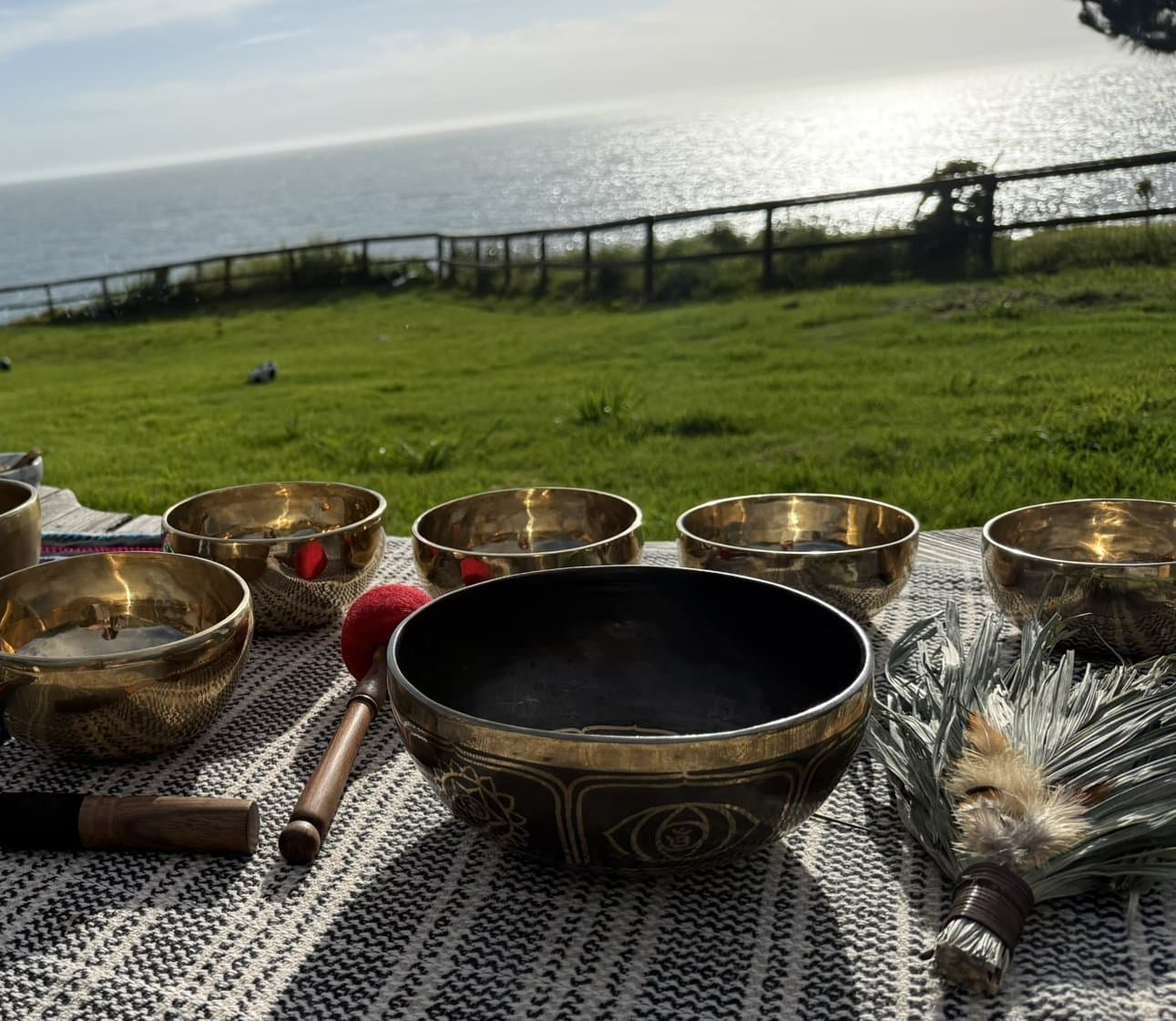
I hold sound ceremonies, and in most of them nobody has taken anything. People lie down, close their eyes, and for ninety minutes or as long as eight hours I play into the room. Over and over I watch the same movement happen: a guarded room settles, wakes up in the body, goes quiet and inward, lets something go, opens, and lands.
Then I read the clinical literature on psilocybin and LSD sessions, and there it is again, nearly beat for beat. Same shape, different room.
That isn't a coincidence. It's a family tree.
2. The family tree
Maryland, 1960s and 70s. At the Maryland Psychiatric Research Center, music therapist Helen Bonny and psychiatrist Walter Pahnke worked on music for LSD psychotherapy. In 1972 they named five things the music was doing: helping the person let go of control and enter the inner world, releasing intense emotion, contributing to a peak experience, providing continuity in timelessness, and directing and structuring the experience [1]. They described six phases of a session, with music suggested for each.
When that research wound down, Bonny didn't stop. She developed the Bonny Method of Guided Imagery and Music: programmed sequences of music, a relaxed listener, a guide, and no drug [2, 3]. A systematic review of longer GIM courses found medium to large effects on anxiety, depression, mood and quality of life [4].
Johns Hopkins, 1999 to today. Bill Richards, who had worked in that same Maryland research, built the Johns Hopkins psilocybin playlist partly from Bonny's programs [5, 6]. It runs for about seven hours and forty minutes and moves through an ascent, a peak and a return. Its descendants are still in use in trials today.
Esalen and after. Stanislav Grof ran LSD psychotherapy for years [7]. With Christina Grof he went on to develop Holotropic Breathwork, which uses breath and music and no drug. Their own description of the music reads like a session map: "at the beginning... evocative and stimulating, later it becomes increasingly dramatic and dynamic, and finally it reaches a breakthrough quality. Following the culmination, it is appropriate to shift gradually to quieter music and end with peaceful, flowing, and meditative selections" [8]. Then the line I'd want every musician to read twice: this sequence "should be modified if the energy in the group suggests that a different pattern is indicated."
The Amazon, long before any of it. In Shipibo ayahuasca ceremony, the healer sings icaros through the night. Recent studies at the Takiwasi Center in Peru found participants describing the songs as what helped them feel safe while moving through difficult memories and emotions [9, 10].
The dance floor. Gabrielle Roth's 5Rhythms, born in the 1970s and also shaped at Esalen, runs a single wave through five rhythms: Flowing, Staccato, Chaos, Lyrical, Stillness. Roth paired each with an emotion: fear, anger, sadness, joy, compassion [11].
Line these up and the same shape appears: Bonny's phases, Grof's evocative-to-meditative sequence, the Hopkins ascent, peak and return, Roth's wave. Some of these lineages share a direct ancestor; others arrived at the same shape on their own. Either way, the shape came first and the medicine was optional.
3. What the medicine changes
If the arc can run without a drug, what does the drug add? The best answer in the research is sensitivity. A psychedelic makes the music matter more.
- Under LSD, music evoked stronger emotion, especially wonder, transcendence, power and tenderness [12].
- Music combined with LSD increased connectivity between memory regions and visual cortex, which tracked with richer eyes-closed imagery, including autobiographical imagery [13].
- LSD made previously meaningless music feel personally meaningful. Blocking the serotonin 2A receptor removed the effect [14].
Then comes the finding that made the field pay attention. In Imperial College's psilocybin trial for treatment-resistant depression, Mendel Kaelen and colleagues interviewed nineteen patients about the music [15]. How much a patient liked the music, how well it resonated with their state, and how open they were to it each predicted their drop in depression a week later. The intensity of the drug experience did not. Fifteen of the nineteen described the music as guidance: a vehicle that carried them, a source of grounding and reassurance. The paper's title says it plainly: "The hidden therapist."
So the medicine turns the volume up on meaning. That cuts both ways. Nine of those nineteen patients also described resisting the music at some point, and some said it intensified feelings they didn't want, or felt like being "misguided" [15]. When the medicine amplifies everything, a wrong turn in the music is amplified too.
That's the core difference between the two rooms. Without medicine, the music has to supply more of the momentum. With medicine, the music has to be far more careful, because it can't help being powerful.
4. Where the evidence runs out
The claims need edges, so here are the edges.
Ketamine. The only randomized trial of music during ketamine treatment found no difference in outcomes or in the psychedelic experience between people who had music and people who didn't [16]. Both groups improved a lot. Maybe music matters less in short, strongly dissociative sessions. Maybe a trial of thirty-two people couldn't detect the difference. Either way, "music is essential" isn't a claim that holds for every medicine.
MDMA. A 2026 review found no quantitative studies of music with MDMA at all [17]. In the MAPS protocols, music and eyeshades are offered "if they wish," and talking is frequent [18]. It's a different kind of session, and the research hasn't caught up with it.
The arc itself. One recent analysis of eight research playlists found that their actual acoustics don't follow a consistent onset, peak and return [19]. It's a preprint, not yet peer-reviewed. Still, it's a fair warning: the arc is a principle the field agrees on, not yet a measured fact about every playlist.
Drug-free practice. The evidence here is real but mostly lighter. A singing bowl study found tension, anger, fatigue and depressed mood dropped after one session, but it had no control group [20]. A survey of over a thousand conscious dancers reported strong benefits, but its participants chose themselves [21]. No controlled trial of 5Rhythms exists. I found no good study on volume in any of these settings. Claims you may have heard about specific "healing frequencies" from bowls or gongs aren't supported by the peer-reviewed work I could find, and I don't make them.
What remains is still a lot. Across every one of these rooms, the people who study them and the people in them describe the music the same way: as the thing that carries them.
5. What the research says about the shape
I work from a map of my own: six stages, each with the emotions likely to be moving in the room, what the music does and doesn't do there, and how to move to the next. The map stays in the room. What I can share is what the published research says about the shape it follows, the same shape every lineage above arrives at: arrive, wake the body, go in, release, open, come home.
The opening is about safety. People come in guarded, and the first job is to give the nervous system somewhere to rest. Roth puts fear at the start of her wave. You don't push through fear. You give it ground.
The peak wants steadiness. The research on peak music surprised me in a useful way. Experienced guides at Johns Hopkins chose peak music that was regular and predictable, with continuous forward motion that slowly builds, a relatively slow tempo and darker color [22]. Brain imaging of shamanic practitioners in drum-driven trance showed the brain partly tuning the repetitive drum out [23]. The peak isn't the moment for your best ideas. It's the moment to be steady enough that people can stop tracking you and let go.
The build matters as much as the arrival. The brain's reward system responds to both: dopamine rises in anticipation of the peak and again at the peak itself [24]. The build is part of the experience in its own right.
Silence is a tool. It turns out to be one of the best-supported tools of all. In one study, a two-minute pause after music dropped heart rate, blood pressure and breathing below the listener's starting baseline [25]. Silence may be where much of the work lands.
One thing holds in both rooms: the healing belongs to the person. The sound helps guide a nervous system out of vigilance and into the parasympathetic state, where the body does its own settling and repair.
6. Six principles that hold in both rooms
- Shape the arc, and be ready to leave it. Every lineage uses one. Grof wrote the permission to break it into his own instructions. The map serves the room, not the other way around.
- Fit beats taste. In the Imperial study, resonance (music matching the person's inner state) predicted outcomes [15]. A beautiful track that pushes against where someone is feels like being misguided.
- At the peak, be steady. Predictable, slowly building, forward-moving [22]. Let the rhythm carry people so they can stop holding themselves up.
- Words steer. Clinical programs favor no lyrics, or lyrics in a language the listener doesn't speak, because familiar words tell people what to feel [15, 26]. Voice is welcome. Instructions hidden in a song usually aren't.
- Resistance is information. Nearly half of the Imperial patients resisted the music at some point [15]. Sometimes the resistance is the work, and the right move is to invite someone to stay with it [26]. Sometimes the music is simply wrong for them, and the right move is to change it. Telling the two apart is the craft.
- Choice matters. MAPS offers music "if they wish" [18]. In a Hopkins study, people chose their music for a later session, and six of ten chose overtone-based sound (bowls, gongs, drones) over Western classical [27]. The authors asked whether classical music holds any unique benefit at all.
There's an honest tension underneath principles 2 and 6. Bill Richards wrote that the supportive structure of the music matters more than anyone's personal preference [5]. A review of the field found that participant-centered music goes with better outcomes [2]. A Johns Hopkins trial now recruiting is testing personally meaningful music against the standard playlist [28]. I don't think the answer is either one. Structure is what holds a person. Fit is what lets them trust being held. A live musician in the room can offer both: a shape that doesn't waver, and attention to the person inside it.
7. What this asks of musicians
If the arc lives in the music, then the people making that music need training that doesn't yet exist as a single discipline. Some of it does exist, in pieces:
- Bonny Method of Guided Imagery and Music training, through the Association for Music and Imagery: at least two years, supervised, the deepest existing training in music-guided inner work [29].
- Grof Transpersonal Training, the certification for Holotropic Breathwork facilitators [30].
- The CIIS Certificate in Psychedelic-Assisted Therapies and Research, for the clinical side [31].
- Reading: Richards' Sacred Knowledge, Bonny and Pahnke's 1972 paper, the Copenhagen group's open-access guide to building a psilocybin music program [26], Roth's Maps to Ecstasy.
None of them teach the thing a live musician actually does: read a room's breathing and answer it with sound, in the moment, with or without a medicine in anyone's system. That craft is learnable. It has stages, emotions to expect at each one, mistakes to avoid and ways to recover from them. I've mapped that craft stage by stage, and I teach it privately to artists through coaching and immersions. Get in touch to ask about it.
8. One discipline
Medicine and no medicine are one field, and its shape was always carried by the sound. The medicine changes how much each note weighs. It doesn't change what the notes are for.
The practical upshot is simple. Learn the arc. Learn the emotions that tend to move at each stage. Learn when to hold steady and when to change course. Then bring all of it into whatever room you're in: a clinic, a ceremony, a floor full of dancers, or a room of people lying down in the dark with nothing in their systems but their own breath.
---
References
- Bonny HL, Pahnke WN. The use of music in psychedelic (LSD) psychotherapy. J Music Ther. 1972;9(2):64–87.
- O'Callaghan C, Hubik DJ, Dwyer J, Williams M, Ross M. Experience of music used with psychedelic therapy: a rapid review and implications. J Music Ther. 2020;57(3):282–314.
- Bonny HL, Savary LM. Music and Your Mind. Harper & Row; 1973.
- McKinney CH, Honig TJ. Health outcomes of a series of Bonny Method of Guided Imagery and Music sessions: a systematic review. J Music Ther. 2017;54(1):1–34.
- Richards WA. Sacred Knowledge: Psychedelics and Religious Experiences. Columbia University Press; 2015.
- Johns Hopkins Medicine. Inside the Johns Hopkins psilocybin playlist. 2020.
- Grof S. LSD Psychotherapy. Hunter House; 1980.
- Grof S, Grof C. Principles of Holotropic Breathwork. 1990.
- Graham OJ, Rojas Saucedo G, Politi M. Experiences of listening to icaros during ayahuasca ceremonies at Centro Takiwasi. Anthropol Consciousness. 2023;34(1):35–67.
- Sherwin M, Friso F, Fachner J, Politi M. Participant experiences of icaros during a traditional medicine ceremony at the Takiwasi Center. J Psychedelic Stud. 2025;9(2):149–168.
- Roth G. Maps to Ecstasy. 1989.
- Kaelen M, Barrett FS, Roseman L, et al. LSD enhances the emotional response to music. Psychopharmacology. 2015;232(19):3607–3614.
- Kaelen M, Roseman L, Kahan J, et al. LSD modulates music-induced imagery via changes in parahippocampal connectivity. Eur Neuropsychopharmacol. 2016;26(7):1099–1109.
- Preller KH, Herdener M, Pokorny T, et al. The fabric of meaning and subjective effects in LSD-induced states depend on serotonin 2A receptor activation. Curr Biol. 2017;27(3):451–457.
- Kaelen M, Giribaldi B, Raine J, et al. The hidden therapist: evidence for a central role of music in psychedelic therapy. Psychopharmacology. 2018;235(2):505–519.
- Greenway KT, Garel N, Dinh-Williams LL, et al. The Music for Subanesthetic Infusions of Ketamine randomised clinical trial. Br J Psychiatry. 2026;228(5):437–445.
- Rowe T, Hurzeler T, Towers E, Louie E, Morley KC. Psychedelic therapy and the role of music: a scoping review. Brain Behav. 2026;16(6):e71533.
- MAPS. MDMA-assisted psychotherapy treatment manual.
- Gómez-Cañón JS, Leininger C, Mayall D, Dougherty RF, Bowling DL. Music for psilocybin therapy and the temporal arc of psychedelic experience. Preprint, Research Square. doi:10.21203/rs.3.rs-10403919/v1.
- Goldsby TL, Goldsby ME, McWalters M, Mills PJ. Effects of singing bowl sound meditation on mood, tension, and well-being. J Evid Based Complementary Altern Med. 2017;22(3):401–406.
- Laird KT, Vergeer I, Hennelly SE, Siddarth P. Conscious dance: perceived benefits and psychological well-being of participants. Complement Ther Clin Pract. 2021;44:101440.
- Barrett FS, Robbins H, Smooke D, Brown JL, Griffiths RR. Qualitative and quantitative features of music reported to support peak mystical experiences during psychedelic therapy sessions. Front Psychol. 2017;8:1238.
- Hove MJ, Stelzer J, Nierhaus T, et al. Brain network reconfiguration and perceptual decoupling during an absorptive state of consciousness. Cereb Cortex. 2016;26(7):3116–3124.
- Salimpoor VN, Benovoy M, Larcher K, Dagher A, Zatorre RJ. Anatomically distinct dopamine release during anticipation and experience of peak emotion to music. Nat Neurosci. 2011;14(2):257–262.
- Bernardi L, Porta C, Sleight P. Cardiovascular, cerebrovascular, and respiratory changes induced by different types of music in musicians and non-musicians: the importance of silence. Heart. 2006;92(4):445–452.
- Messell C, Summer L, Bonde LO, Beck BD, Stenbæk DS. Music programming for psilocybin-assisted therapy: Guided Imagery and Music-informed perspectives. Front Psychol. 2022;13:873455.
- Strickland JC, Garcia-Romeu A, Johnson MW. Set and setting: a randomized study of different musical genres in supporting psychedelic therapy. ACS Pharmacol Transl Sci. 2021;4(2):472–478.
- PRoMiSS: Psilocybin and the Role of Music in Set and Setting. ClinicalTrials.gov NCT07180108.
- Association for Music and Imagery / Bonny Method training (Appalachian State University).
- Grof Transpersonal Training. holotropic.com.
- California Institute of Integral Studies. Certificate in Psychedelic-Assisted Therapies and Research.
Cite this essay
This is the essay’s permanent address. Quote it, argue with it, build on it; a citation is all I ask.
Wells D. The Arc Lives in the Music: What psychedelic research and sound ceremony share. dustinwells.com; November 1, 2026. https://www.dustinwells.com/essays/the-arc-lives-in-the-music