- Author
- Dustin Wells
- Published
- Reading time
- 12 minutes
This essay is the written form of a talk of the same name, proposed for Psychedelic Science 2027 (MAPS), Denver, May 2027. The practice it describes is the one I hold in live sound ceremonies, most recently the 2026 series at the Wilkinson Public Library in Telluride, Colorado.
Abstract
For four decades, psychedelic experience has been designed around two conditions: set, the mindset a person brings, and setting, the environment they are placed in. Sound has been filed under setting, as a playlist, a feature of the room. This essay argues that the filing is wrong. Set and setting are conditions: established before the experience and fixed once it begins. Sound is a process. It unfolds in time alongside the experience, it acts on the inner state and the outer environment at once, and it is the only element in the room a facilitator can change in the exact moment something is happening. Clinical protocol, neuroscience, and Indigenous lineage already treat sound as structural; the language has not caught up. Naming sound as a third condition, co-equal with set and setting, gives it what the other two have: a discipline, with training, ethics, calibration, and research design of its own.
Keywordsset, setting, and sound · set and setting · music in psychedelic therapy · the hidden therapist · sound ceremony · parasympathetic state
1. The framework we inherited
Timothy Leary and his colleagues gave the field “set and setting” in the early 1960s [1]. Norman Zinberg made it a science in 1984 with Drug, Set, and Setting, which argued that the effects of a drug cannot be understood apart from the mindset of the person taking it and the social and physical environment they take it in [2]. Ido Hartogsohn has traced how thoroughly that framework came to organize the field: preparation, screening, room design, integration, all of it hangs on those two words [3].
Notice that Zinberg’s original triad had three legs: drug, set, and setting. In a therapy room the drug is a given, the protocol fixes it, and so attention collapsed onto the remaining two. The field has been comfortable with a third leg before. It just kept the wrong one.
Everyone doing this work has spent years thinking about set, and thinking about setting. We screen for mindset. We design the room: the couch, the eye mask, the art on the wall, the weighted blanket. And then, for the one element that will move every nervous system in that room, we reach for a playlist.
2. So what shifted?
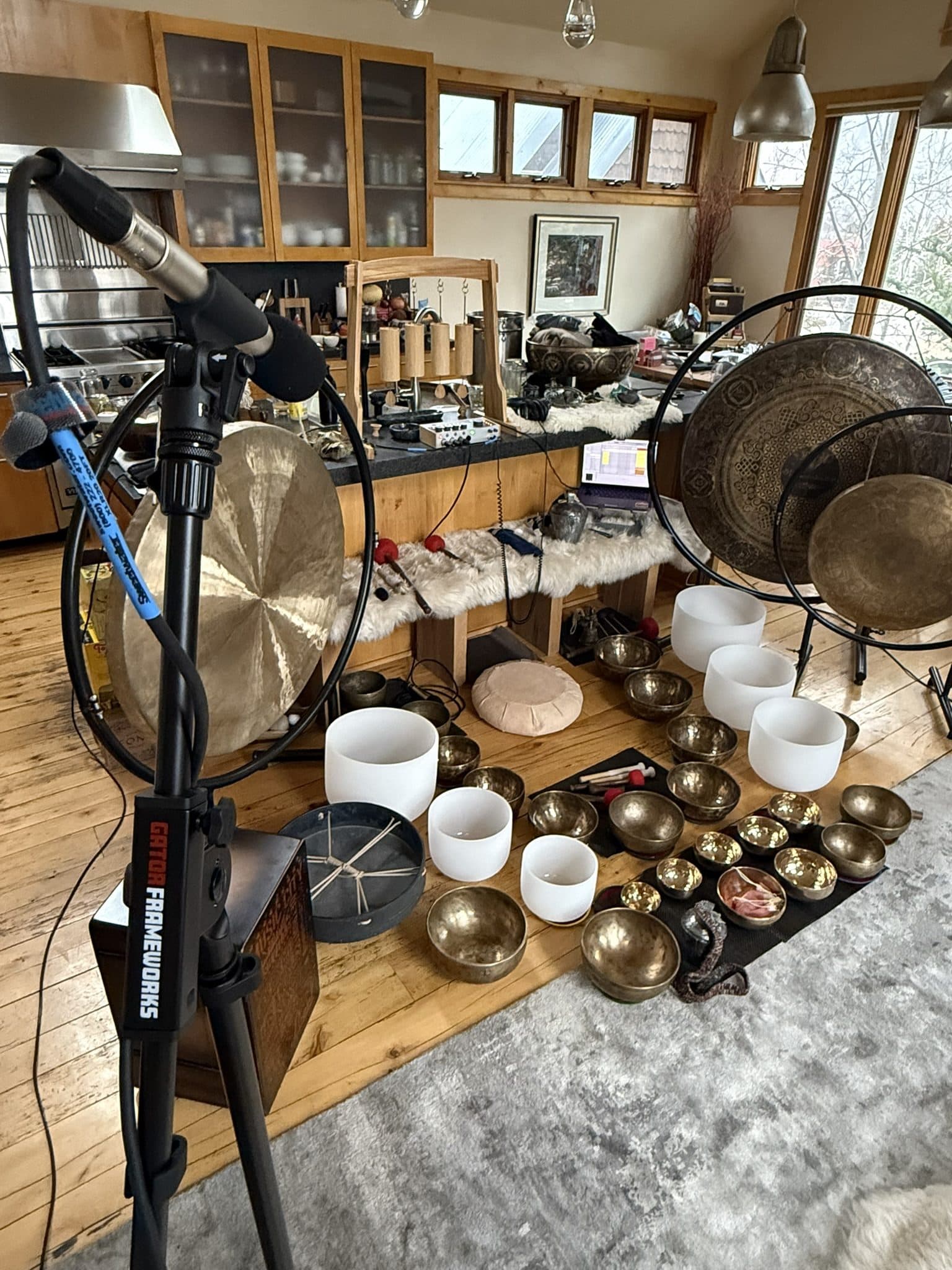
I hold live sound ceremonies. People lie down in a room, a library, a gallery, a yurt, and for ninety minutes or two hours I play: gongs, singing bowls, shamanic drums, crystal bowls, chimes, voice, guitar, synthesizers, and field recordings of water and wind, placed around the room and moved in real time. No playlist. Nothing pre-recorded.
Here is what I watch happen in the first ninety seconds, every time. A long tone, a bowl under a held voice, blooms and decays into silence. Somewhere in that minute, shoulders come down. Breath gets longer. Something in the room lets go, and nobody decided to do it.
The room did not change. Same chairs, same lights, same carpet. The people did not change. Each of them walked in with the same day behind them and the same list in their head; their mindset is exactly what it was ninety seconds earlier. Set held still. Setting held still. Something moved every body in the room anyway.
If it can move a room while set and setting are both fixed, it cannot be a sub-item of one of them. It is a third thing.
3. Three claims
Three observations from practice. Each holds on its own.
3.1 Set and setting are conditions. Sound is a process.
Set is what you bring. Setting is where you are placed. Both are conditions in the strict sense: you establish them before the medicine comes up, and then they are fixed. You cannot redecorate the room at the peak. You cannot re-screen someone’s childhood mid-journey. The whole craft of set and setting is front-loaded, and the field is very good at it.
Sound is different in kind. It is not a condition; it is a process. It moves through time, right alongside the journey, and it is the only element in the room that can be changed in the exact second something is happening. In ceremony I will hold a note and bend it slowly downward while a room is listening, and I can feel the room go under with it. Nobody can do that with a couch.
A shorthand I use: set is the driver, setting is the road, sound is the steering wheel.
| Set | Setting | Sound | |
|---|---|---|---|
| What it is | The mindset, history, intention, and expectation a person brings | The physical and social environment the experience happens in | The acoustic environment as it unfolds: silence, music, voice, the room’s own sound |
| When it is established | Before | Before | Before, and continuously during |
| Changes mid-experience? | Not by design | Not by design | By design, moment to moment |
| Who can steer it in real time | No one | No one, meaningfully | The facilitator or musician |
| Where it acts | Inside | Outside | Enters from outside, acts inside |
3.2 Sound acts on set and setting at once.
Sound is the only element that works on both at the same time. It enters through the setting, it is in the room, physically, as pressure, but it does its work on the set.
A slow, steady drum somewhere near resting heart rate does not stay in the room. It goes into the chest. Slow the drum deliberately over twenty seconds and a room’s breathing follows it down. The heart is negotiating with a drum. That is not a feature of the environment anymore; it is a carrier wave between the outer world and the inner one. A thing that touches both cannot be a sub-item of either.
3.3 The job is state, not song.
In this work, the task is not to play good music. Play three notes on bowls, prettily, as ambiance: that is a song. Play the same three notes slower, each one placed on the room’s exhale, with your attention on the room and not the bowls: that is a state. Same notes. What changed was what the player was listening to. Not the melody. The people.
That is the practitioner’s whole discipline in four words: state, not song. It is also why a playlist, however well curated, is a different category of thing from a musician present in the room. A playlist is a setting decision, made in advance. A musician reading a room is a process, made in the moment.
One thing needs saying plainly, because the framing matters. The sound does not heal anyone. Neither do I. What the sound does is guide a nervous system out of vigilance and into the parasympathetic state, the state in which the body does its own settling and its own repair. The healing belongs to the person. The sound is how they are met on the way there.
4. What the research already knows
I am a practitioner, not a researcher. But the case for a third condition does not rest on practice alone. The lab, the neuroscience, and the lineage already treat sound as structural. Only the language lags.
Johns Hopkins. In the Hopkins psilocybin studies, music is not background. It is protocol. Bill Richards built a sequenced program with a deliberate emotional arc, ascent, peak, return, drawing partly on Helen Bonny’s music-therapy work, and that program is written into the session [4, 5]. Barrett and colleagues at Hopkins and the Peabody Institute then documented which features of that music participants reported as supporting peak experiences [4]. A research group does not sequence and document an amenity. It sequences and documents a variable.
Imperial College London. Mendel Kaelen and colleagues interviewed nineteen patients treated with psilocybin for treatment-resistant depression and titled the paper “The hidden therapist” [6]. Their finding: how a patient experienced the music was significantly predictive of their reduction in depression a week later. The intensity of the drug experience was not. Sit with that. The music predicted the outcome. The dose did not. A later randomized study at Hopkins compared musical genres in psilocybin sessions, again treating music as a manipulable variable rather than a fixture of the room [7].
The Amazon. The Shipibo-Conibo healers of the Peruvian Amazon never needed the study. In ceremony, the healer sings. The icaro is not accompaniment to the journey; in the healer’s own account it is the steering, bound to the visionary geometry the participant sees [8, 9]. Ethnomusicologist Bernd Brabec de Mori has documented these songs as the healer’s working instrument, and traced how far back the practice runs [10]. We did not discover that sound steers a psychedelic experience. We demoted it.
The nervous system. There is also a mechanism, and it is not mysterious. Natural soundscapes, water, wind, birdsong, raise parasympathetic activity as measured by heart-rate variability and turn attention outward, with the largest effect in the most stressed listeners [11]. A synthesis of eighteen studies found natural sounds lower stress and improve affect, water most of all [12]. The reason is old. A full birdscape and running water are what the world sounds like when nothing is hunting you; they are absence-of-threat information the body reads directly. Under that bed, a sustained drone gives the brain’s predictive machinery nothing to check and nothing to brace for [13]. It is a stable floor. Only on top of that floor does the steering begin. This is why, under almost everything I play, there is water or wind, and under that a single held note.
None of these sources treats sound as decoration. They treat it as a determinant. They simply have not agreed on a word for what kind of determinant it is.
5. Objections
Isn’t this just part of setting? Setting sits still. Sound does not. It moves with the person and it moves the person. A thing that acts on the inside cannot be a fixture of the outside. When a category contains one member that behaves unlike every other member, the category is wrong, not the member.
Music is too personal to standardize. So is the room, and the field managed to write principles for it, safety, comfort, predictability, without dictating the paint color. The same move is available here: principles, not playlists. The Hopkins genre study [7] and Kaelen’s later work on adaptive music for therapy are already that move.
This is ceremony, not clinic. Hopkins is a clinic. Imperial is a clinic. They are already doing this. I am asking the field to name what its best protocols already practice.
Naming it changes nothing. What is not named is not designed on purpose. It is not trained for, not consented to, not calibrated, not studied. Naming is what makes the rest possible.
6. What naming it changes
Give sound its own name and it gets what set and setting already have: a discipline. Four things follow.
- Training. Facilitators are trained to prepare a mindset and to hold a room. They are not, as a rule, trained to read a room’s breathing and answer it with sound. That is a teachable skill, and it belongs in the curriculum beside the other two.
- Ethics and consent. If sound can steer a journey, the person being steered should know it, and the person steering should have standards. Preparation conversations that cover set and setting should cover sound.
- Calibration. Volume, placement, tempo, timbre, and the arc across a session are decisions. Principles can be written for them the way principles were written for the room.
- Research design. Sound should be a studied variable, not a controlled-for afterthought. The Kaelen finding, that the experience of the music predicted the clinical outcome, is exactly the kind of result that gets found once sound is treated as its own condition, and exactly the kind that stays hidden while it is filed under setting.
7. The ask
Add the third word. In protocols, in training, in research design, in consent conversations. Picture the next decade of trials in which the sound is a studied variable and not an afterthought. Picture what it means for someone mid-journey to be met, in real time, by the one element in the room that can move with them.
And then listen for it. Once you have heard what sound is actually doing in that room, you cannot un-hear it.
Set. Setting. And sound.
A note on priority
The three words have been paired before, most visibly by clinical pharmacist and writer Stephanie Karzon Abrams, whose 2025 newsletter “Set. Setting. Sound.” surveyed music that suits psychedelic experience [14]. That piece, like the wider literature, treats sound as something to curate within the setting. To my knowledge, this essay is the first to argue that sound is a condition of a different kind, a process rather than a fixture, acting on set and setting at once and steerable in real time, and the first to propose “set, setting, and sound” as a three-part framework for how psychedelic experience is designed, taught, and studied. I would welcome correction.
References
- Leary T, Litwin GH, Metzner R. Reactions to psilocybin administered in a supportive environment. Journal of Nervous and Mental Disease. 1963;137(6):561–573.
- Zinberg NE. Drug, Set, and Setting: The Basis for Controlled Intoxicant Use. New Haven: Yale University Press; 1984.
- Hartogsohn I. Constructing drug effects: A history of set and setting. Drug Science, Policy and Law. 2017;3:1–17. doi:10.1177/2050324516683325
- Barrett FS, Robbins H, Smooke D, Brown JL, Griffiths RR. Qualitative and quantitative features of music reported to support peak mystical experiences during psychedelic therapy sessions. Frontiers in Psychology. 2017;8:1238.
- Johns Hopkins Medicine. Inside the Johns Hopkins psilocybin playlist. October 2020.
- Kaelen M, Giribaldi B, Raine J, Evans L, Timmerman C, Rodriguez N, Roseman L, Feilding A, Nutt D, Carhart-Harris R. The hidden therapist: evidence for a central role of music in psychedelic therapy. Psychopharmacology. 2018;235(2):505–519.
- Strickland JC, Garcia-Romeu A, Johnson MW. Set and setting: A randomized study of different musical genres in supporting psychedelic therapy. ACS Pharmacology & Translational Science. 2021;4(2):472–478.
- Gebhart-Sayer A. The geometric designs of the Shipibo-Conibo in ritual context. Journal of Latin American Lore. 1985;11(2):143–175.
- Graham OJ, Rojas Saucedo G, Politi M. Experiences of listening to icaros during ayahuasca ceremonies at Centro Takiwasi: An interpretive phenomenological analysis. Anthropology of Consciousness. 2023;34(1):35–67.
- Brabec de Mori B. Tracing hallucinations: Contributing to a critical ethnohistory of ayahuasca usage in the Peruvian Amazon. In: Labate BC, Jungaberle H, eds. The Internationalization of Ayahuasca. Zürich: LIT Verlag; 2011:23–47.
- Gould van Praag CD, Garfinkel SN, Sparasci O, Mees A, Philippides AO, Ware M, Ottaviani C, Critchley HD. Mind-wandering and alterations to default mode network connectivity when listening to naturalistic versus artificial sounds. Scientific Reports. 2017;7:45273.
- Buxton RT, Pearson AL, Allou C, Fristrup K, Wittemyer G. A synthesis of health benefits of natural sounds and their distribution in national parks. Proceedings of the National Academy of Sciences. 2021;118(14):e2013097118.
- Koelsch S, Vuust P, Friston K. Predictive processes and the peculiar case of music. Trends in Cognitive Sciences. 2019;23(1):63–77.
- Abrams SK. Set. Setting. Sound. Psychedelics Uncensored newsletter; 2025. stephaniekarzonabrams.substack.com/p/set-setting-sound
Cite this essay
This is the essay’s permanent address. Quote it, argue with it, build on it; a citation is all I ask.
Wells D. Set, Setting, and Sound: Why the Third Condition Deserves Its Own Name. dustinwells.com; September 13, 2026. https://www.dustinwells.com/essays/set-setting-and-sound