Technology
Some of my instruments are thousands of years old. Some I wrote myself.
Everything I do — ceremony, retreat, coaching — runs on technologies of transformation. The oldest is sound. The newest is software. They serve the same purpose: changing human state, reliably.
The original technology
Sound
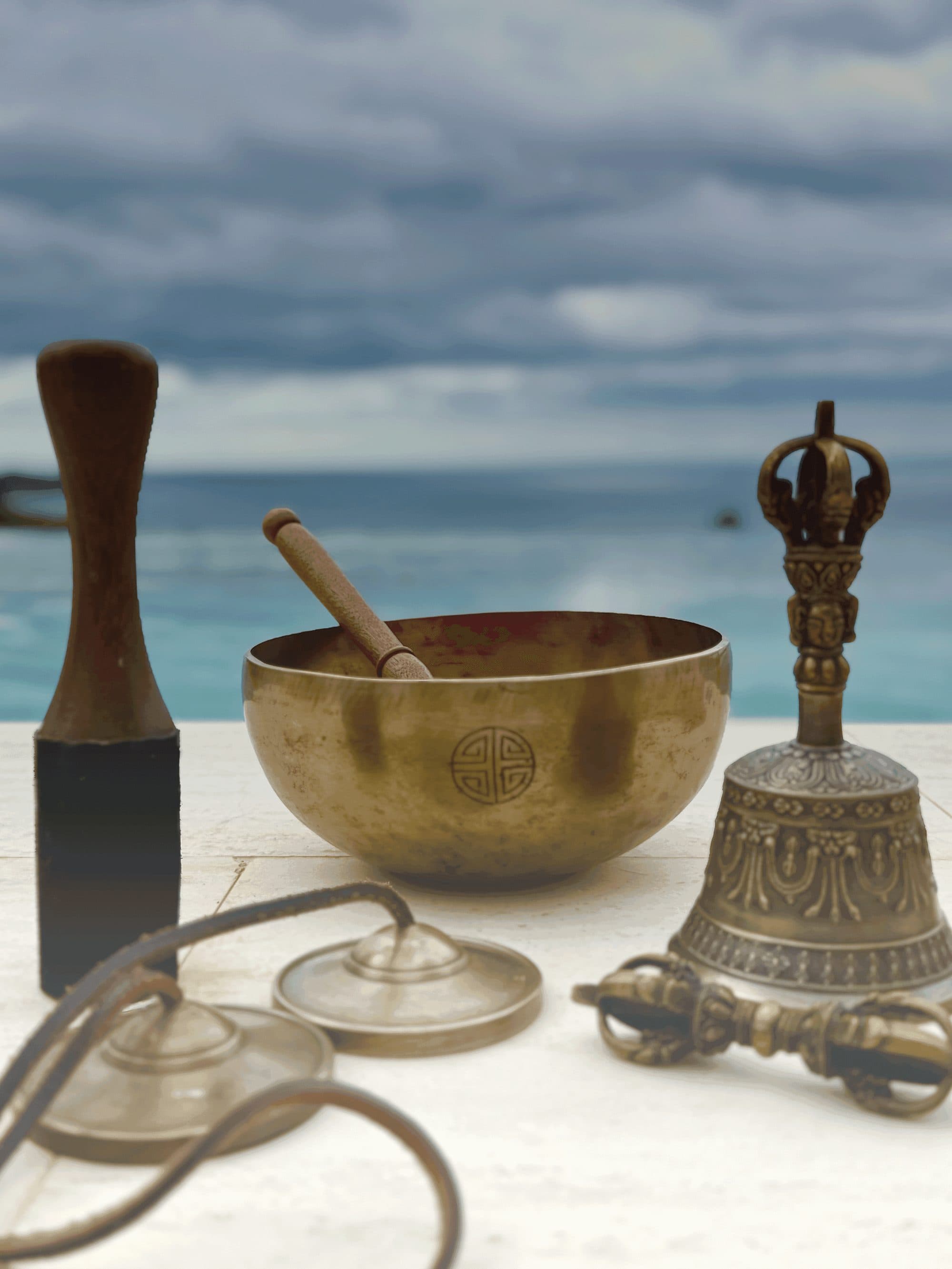
A tone can settle a nervous system. A rhythm can move what conversation can’t reach. Long before language, sound was how humans gathered, grieved, and celebrated — and it works as precisely today as it ever did. Bowls, voice, percussion, strings: instruments refined over thousands of years for exactly this purpose.
Built for the room
The instrument system
Years of design went into the live rig — custom- programmed hardware and software organized not by instrument, but by state: grounding, safety, release, expansion. It lets one musician read a room and answer it in real time, the way a conversation answers a question.
Everything is played. Nothing is a backing track. What follows is what is actually in the room.
The how
What’s actually in the room
Sacred instruments
Gongs, singing and crystal bowls, bells, chimes, shamanic drums, rattles — most chosen in person in Nepal and Bali, from the people who make them.
Strings, keys, voice
Guitar, keyboard, and voice. The parts of the evening that answer the room directly, and the reason a ceremony can turn on a single held note.
Live looping
A phrase played once, captured, and stacked under the next — one player becoming an ensemble in front of you, with nothing pre-recorded underneath.
Synthesis and texture
Pads, drones, and shaped noise, programmed by state rather than by patch name: grounding, safety, release, expansion.
Field recordings
Water, wind, birds, the hum of a particular room — carried in and placed under the music the way a film places a landscape behind a face.
The room itself
Every space is different, and the rig gets built for the one it’s in. What carries across all of them is placement — sound arriving from more than one direction and moved around the room in real time. You are inside the mix, not in front of it.
None of it runs to a click or a setlist. A ceremony is built in the room it happens in, in the order that room turns out to need — which is why the same instruments never make the same evening twice.
The through line
Ancient practice, modern precision — the same craft, end to end.
The companion
Proprietary software for the work between the work.
Transformation doesn’t happen in a single evening — it happens in the days and weeks after. So I built companion software for exactly that: daily practices, intentions, and reflection across eight areas of life. The clarity is already in you; the technology just keeps you close to it.
Available to anyone
108 Moments
One practice a day, one moment at a time.
A practice you carry into an ordinary day. Each morning gives you one specific thing to catch yourself noticing. Every time you catch it, you move a bead on an eighteen-bead necklace — so the counting happens in your hand and the phone stays in your pocket. It takes two minutes to begin and seconds at a time after that.
108moments.app (opens in a new tab)In ceremony
The rig shapes sound to the state the room needs, in real time — every journey is played live, never from a playlist.
On retreat
The companion app begins working before you arrive and carries the work through thirty days of guided integration after.
In coaching
Between sessions, daily structure keeps the work alive — intentions, practices, and reflection that compound.