Sound Ceremonies
Music you enter. Sound you feel.
You lie down, close your eyes, and the music comes from all around you. An evening, or a whole day, with nothing to answer — live instruments, sacred instruments, and layered electronics, moving at the pace of a room that is slowly letting go.
What is a sound ceremony?
Closer to a listening practice than a concert. Closer to a concert than a meditation.
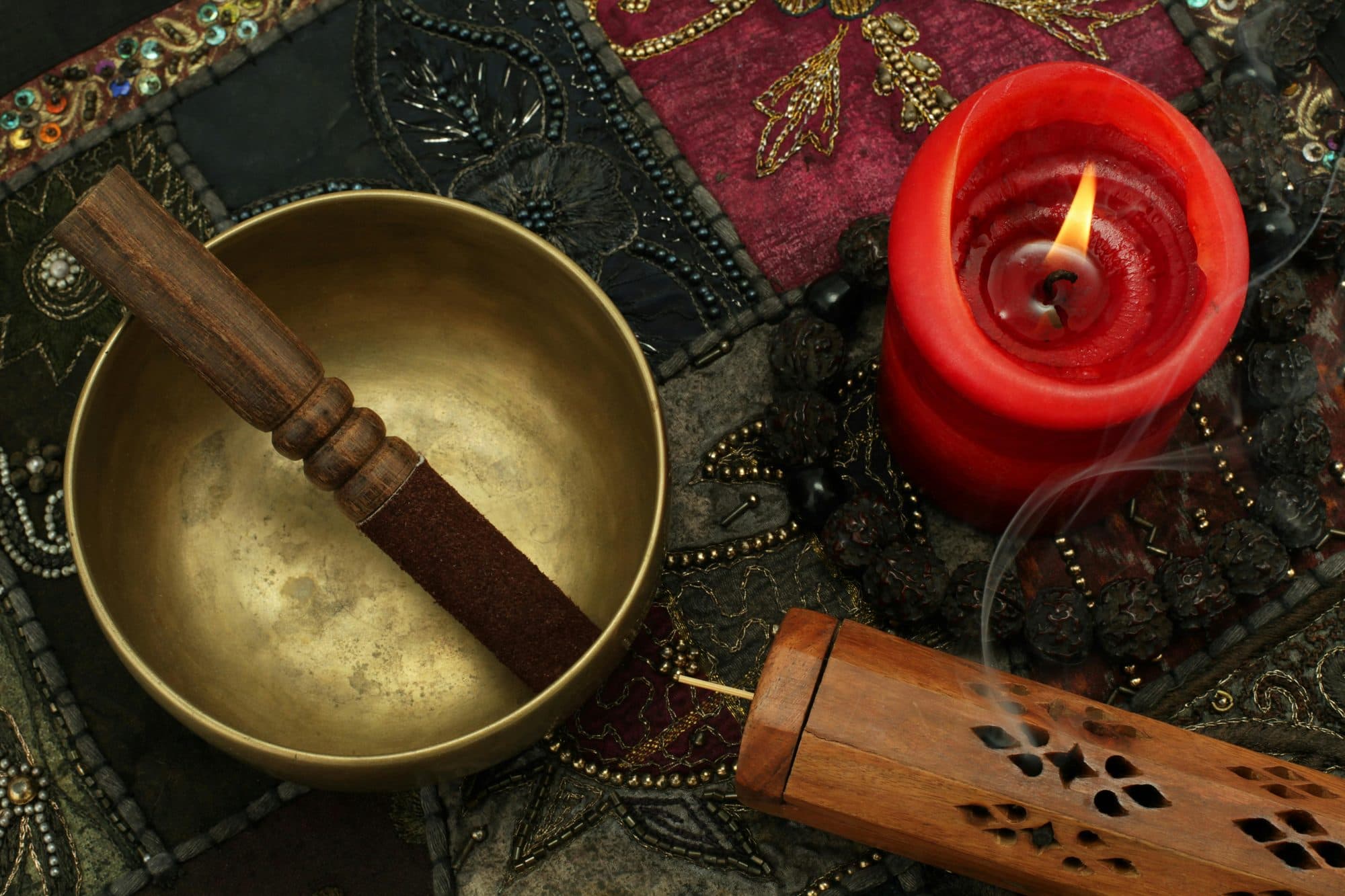
The foundation is sacred instruments: gongs, shamanic drums, rattles, singing bowls, crystal bowls, bells, wind chimes — most of them chosen in person, in Nepal and Bali, from the people who make them. Layered over those are electronic ones: synths, piano, and textures shaped live. Woven through all of it, guitar and voice.
Much of it is built in front of you. A phrase is played once, captured by a looper, and stacked under the next one, so a single player becomes an ensemble without anyone pressing play on a track. And some of it isn’t an instrument at all — I carry field recordings of water, wind, birds, and the hum of particular rooms, and place them under the music the way a film places a landscape behind a face. Nothing here is pre-recorded music, and there is no playlist.
What all of it is for is simple: to give your attention one thing to do, and then to hold it there long enough that it stops working so hard.
The room
Built for the room
Every space is different — a concert hall, a gallery, a retreat center, a ballroom — and each one gets a setup built for it. What stays the same is where you are in the music: sound is placed and moved around you in real time, arriving from more than one direction. You are not in front of the mix. You are inside it.
You arrive in silence, set an intention, and find your place — a mat, a blanket, a pillow. Then the journey begins.
The craft
State, not song
I don’t think of this as playing music. I think of it as guiding nervous systems. Every sound is chosen for the state a moment needs — safety, aliveness, release, expansion — using an instrument rig I’ve designed and programmed over years for exactly this work.
The result is a journey with a deliberate arc — and a guide who is listening to the room as much as the room is listening to him. Presence over performance.
The experience
Whatever needs to move, moves.
The arc
Every ceremony moves through six phases
- 01
Arrival
Settling in. Drone, bowls, breath — the room becomes safe.
- 02
Activation
A pulse enters. The body wakes up and says yes.
- 03
Descent
Density drops away. Space opens for what is underneath.
- 04
Expression
Full sound. Whatever needs to move, moves.
- 05
Expansion
Wide, warm, open. Connection — to self, to the room, to life.
- 06
Integration
A return to the first tone. You leave with what you came for.
The tradition
Listening is a practice, not a reflex
Pauline Oliveros spent forty years arguing that listening is a discipline you take up on purpose — not something your ears do automatically while you get on with your day. She called it deep listening, and built an institute around it.
A ceremony is a room built for exactly that practice, with instruments old enough that the practice predates the name. Nothing about it asks you to believe anything. You lie down and you listen, and the listening does the work.
Why it works
Measurable, not mystical
Sustained attention on sustained sound moves most people into a parasympathetic state within about twenty minutes — the deep rest where the body does its own repair, and the opposite of the low-grade alertness most adults run on all day.
That part isn’t mystical. It’s the same physiology behind slow breathing and long walks. What a ceremony adds is that you don’t have to do anything to get there, and it is far harder to talk yourself out of when the sound is coming from every direction at once.
Good to know
What to expect
- Bring what makes you comfortable on the floor — a mat, blanket, pillow, eye mask, and water.
- No experience needed. There is nothing to do and nothing to get right.
- Nobody is touched, nobody is singled out, and nobody is asked to share. You can leave at any point and no one will follow you out.
- If something big moves, I stay after. Nobody is walked out of a ceremony and straight into a parking lot.
- Gatherings range from ninety-minute journeys to full-day ceremonies of eight hours.
- Sliding-scale tickets, always — this work belongs to everyone who needs it, not just everyone who can afford it.
Upcoming
Join a ceremony
- Sun, Nov 8Live Sound CeremonyWilkinson Public Library · Telluride, Colorado
I’m based in Telluride, Colorado, and I travel for retreats and private gatherings.